


Patrick Bateman's Suits, Decoded: The American Psycho Wardrobe and How to Wear It Today
Contents
- Key Takeaways
- Who Is Patrick Bateman, and Why His Wardrobe Matters
- Two Wardrobes: What the Novel Says vs What the Film Shows
- The Four Hero Looks, Decoded
- Why It Reads as Power: The Engineering Behind the Look
- How to Dress Like Patrick Bateman Today, Without the Costume
- The Satire Everyone Forgets
- FAQ
Patrick Bateman wears 1980s power suits in navy, charcoal, and gray: single- and double-breasted jackets with structured, extended shoulders, contrast-collar shirts, silk ties in controlled patterns, and mirror-polished cap-toe shoes. In the 2000 film, costume designer Isis Mussenden built the look around Cerruti tailoring; the 1991 novel by Bret Easton Ellis instead names Valentino Couture and A. Testoni. The film's four signature suits are a navy windowpane single-breasted, a charcoal pinstripe double-breasted, a gray business suit, and a black tuxedo. The discipline makes it iconic. The 1980s volume dates it.
Key Takeaways
- The wardrobe is two wardrobes. The 1991 novel names Valentino, Rolex, and A. Testoni; the 2000 film puts Cerruti tailoring and a Seiko SNXJ90 on screen. Most guides online blur the two.
- Four hero looks carry the film: a navy windowpane single-breasted, a charcoal pinstripe double-breasted, a gray single-breasted business suit, and a black double-breasted tuxedo.
- Three corrections worth making: the on-screen suits were Cerruti, not Valentino; the watch was a Seiko SNXJ90, not a Rolex; the eyewear was Oliver Peoples O'Malley, not Ray-Ban.
- Adapt the discipline, not the costume. Keep the structure, the contrast collar, and the palette restraint. Drop the oversized 1980s cut, the loud wide pinstripe, and the literal red power tie.

Who Is Patrick Bateman, and Why His Wardrobe Matters
Patrick Bateman is the narrator of Bret Easton Ellis's 1991 novel American Psycho and the central figure of Mary Harron's 2000 film adaptation, played by Christian Bale. He is a Wall Street executive in a world where everyone wears the same suits, eats at the same restaurants, and mistakes one another constantly. The wardrobe is the point of the satire, not a break from it: Bateman dresses as armor and uniform, a set of status signals adopted from inherited-wealth conformity rather than personal taste. Understanding that framing matters, because the internet's reinterpretation of the character gets it almost exactly backwards.
Two Wardrobes: What the Novel Says vs What the Film Shows
Most style guides treat the Bateman wardrobe as one thing. It is two. The novel and the film describe different clothes, different brands, and even a different watch; the gap between them is the most interesting part of the story.
The novel's wardrobe (Bret Easton Ellis, 1991)
Ellis writes Bateman through an obsessive litany of labels, and clothing is where it runs hottest. The prose reads like a stream of brand names (Armani, Cerruti, Zegna, Burberry, Bill Blass, Ralph Lauren) dropped with the precision of a man for whom the label is the identity.
- The dressing monologue names a specific ensemble: an Alan Flusser suit, a Valentino Couture tie, A. Testoni shoes. Flusser, a real menswear authority, functions in the text as a styling reference point: the "correct" way to dress, quoted like scripture.
- The Valentino Couture suit anchors the novel's tailoring identity, a couture-house label standing in for taste bought rather than developed.
- The Rolex is a fixation. The novel's phrasing, a warning not to touch the Rolex, treats the watch as an extension of the body.
- The business-card scene is the purest expression of the whole book. A group of near-identical men compare business cards, agonizing over "subtle off-white coloring" and the "Silian Rail" typeface, each card marginally different and functionally identical. It is the wardrobe logic in miniature: status pursued through micro-signals nobody outside the room could read, among men who are already interchangeable.
What Isis Mussenden actually put on screen (2000 film)
Costume designer Isis Mussenden built the film's look, and the on-screen wardrobe departs from the novel in ways driven partly by taste and partly by which brands agreed to participate.
- Cerruti tailored the suits. According to the film's production history, Cerruti agreed to let Christian Bale wear their clothing, but not in scenes where the character was killing anyone. As a result, the charcoal double-breasted worn in the Paul Allen scene has no confirmed brand attribution.
- The watch is a Seiko, not a Rolex. Rolex declined to have their watches associated with the character, so the production substituted a Seiko SNXJ90: a two-tone automatic with a 37mm steel case, fluted gold bezel, white day-date dial, and Jubilee bracelet. The novel's "Don't touch the Rolex" became the film's "Don't touch the watch."
- The underwear brand changed. Calvin Klein withdrew; Perry Ellis supplied the underwear seen on screen.
- The bag changed. Comme des Garçons reportedly declined to let one of their bags be used to carry a corpse, and Jean Paul Gaultier substituted.
- The eyewear is Oliver Peoples, not Ray-Ban. Bateman wears Oliver Peoples O'Malley frames in the film, commonly misattributed to Ray-Ban. His sunglasses are Ray-Ban Wayfarers, which is likely where the confusion begins.


The Four Hero Looks, Decoded
Four suits do most of the work on screen. Each is a study in the same principles (structure, restraint, precision) applied to a different register.
The Navy Windowpane Single-Breasted
The navy windowpane is Bateman's most wearable suit: a single-breasted, two-button jacket in navy wool with a subtle rust-and-blue windowpane check, worn with a contrast cutaway collar and a striped silk tie.
- Jacket: navy wool with a rust and light-blue windowpane check; two-button, ventless; padded, extended shoulders
- Lapel: notch, set at a low gorge in the 1980s manner
- Shirt & collar: light-blue cutaway-collar shirt, button cuffs
- Tie: blue-and-navy uphill-stripe silk, tied in a half-Windsor
- Accessories: camel knee-length overcoat
- Shoes: black cap-toe derby
This look reads as authority with a degree of accessibility. The windowpane softens the formality just enough; the navy keeps it serious. It says I belong in this room without announcing it.
The Charcoal Pinstripe Double-Breasted (the Power Suit)
The charcoal pinstripe is Patrick Bateman's signature power suit: a double-breasted 6×2 jacket in dark charcoal flannel with wide-spaced white pinstripes and broad peak lapels, worn with a white contrast collar, blue braces, and a light-red tie.
- Jacket: dark charcoal flannel with wide-spaced white pinstripes; double-breasted 6×2 front; wide peak lapels with a 1940s inflection; a deliberately roomy 1980s fit
- Lapel: wide peak, as the double-breasted cut calls for
- Shirt & collar: blue shirt with a white contrast collar; white French cuffs; large round gold cufflinks
- Tie: a light-red patterned tie, or a maroon-with-gold-dots version, depending on the scene
- Accessories: vibrant blue braces with an off-white pattern; the transparent raincoat worn in the Paul Allen scene (the "kill uniform")
- Shoes: black patent perforated cap-toe derbies
This is the most recognizable look in the film. The double-breasted peak-lapel combination is a visual declaration: structured, angular, and deliberately imposing. It is engineered to take up space.
The Gray Single-Breasted Business Suit
- Jacket: gray wool; two-button; low-gorge notch lapel; ventless; a relaxed, voluminous 1980s fit
- Ensemble A: white spread-collar shirt; double cuffs; a yellow silk foulard tie with a maroon floral pattern
- Ensemble B: light-blue cutaway contrast-collar shirt; French cuffs monogrammed "P.D.B." in dark blue; a charcoal silk tie with orange-and-cream boxes; navy-and-red striped braces with brown leather tabs and gold adjusters
- Shoes: black perforated cap-toe oxfords
This is the everyday office uniform: disciplined, controlled, precise. The monogrammed cuff and coordinated braces show a man who treats routine dressing as a system.
The Black Double-Breasted Tuxedo
- Jacket: double-breasted 6×2 with satin-faced wide peak lapels; silk-covered buttons; padded, extended shoulders; ventless
- Shirt: white pleated-bib point-collar with four yellow-gold studs; double cuffs; gold links
- Tie: black satin butterfly bow tie
- Trousers: satin-stripe, worn with white triple-stripe braces
- Shoes: black patent oxfords
This is 1980s formalwear at its most architectural: the tuxedo worn as a second skin rather than an occasion costume. If you are weighing whether an event calls for formalwear at all, it helps to understand how a tuxedo differs from a suit before committing to either.


Why It Reads as Power: The Engineering Behind the Look
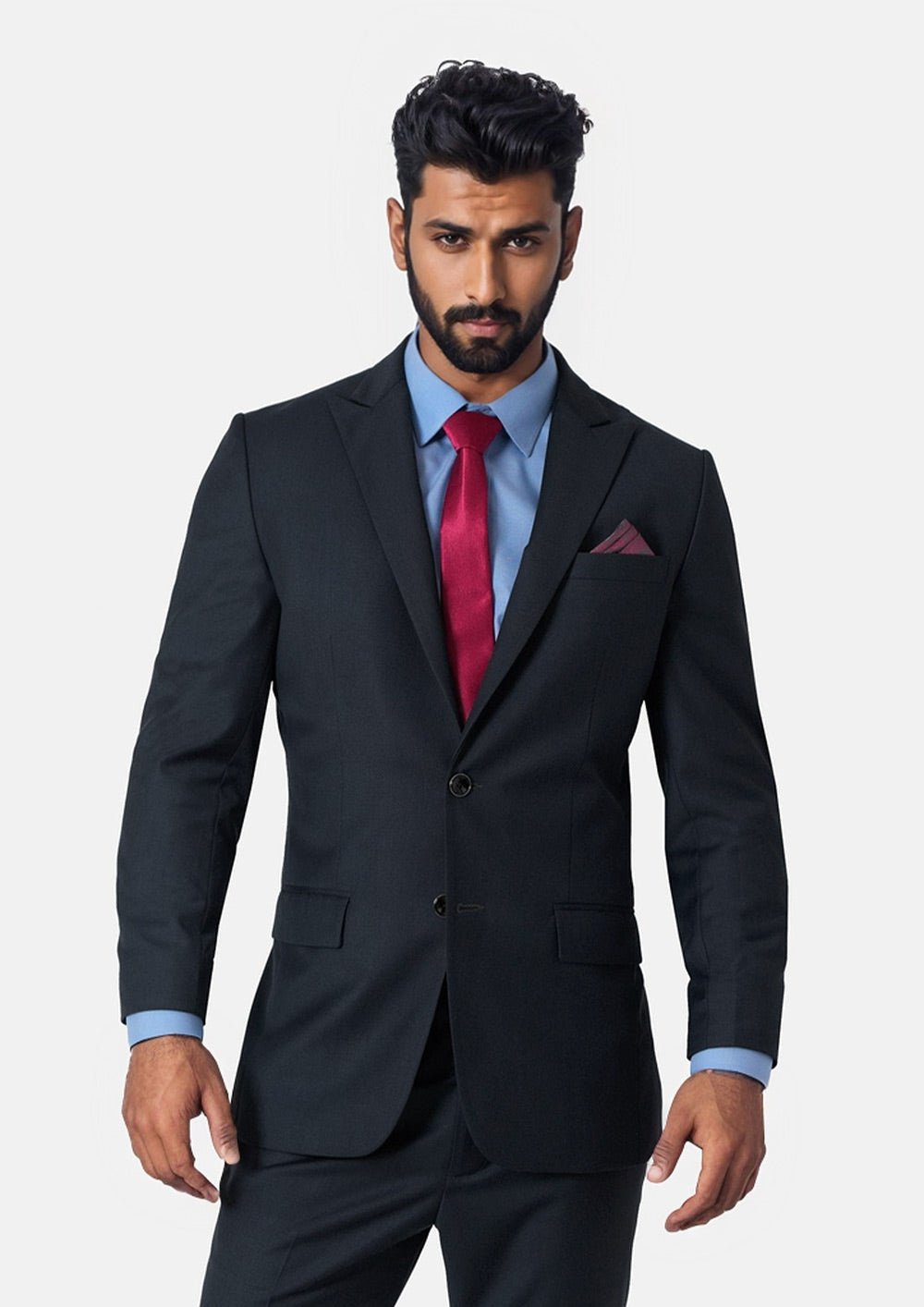
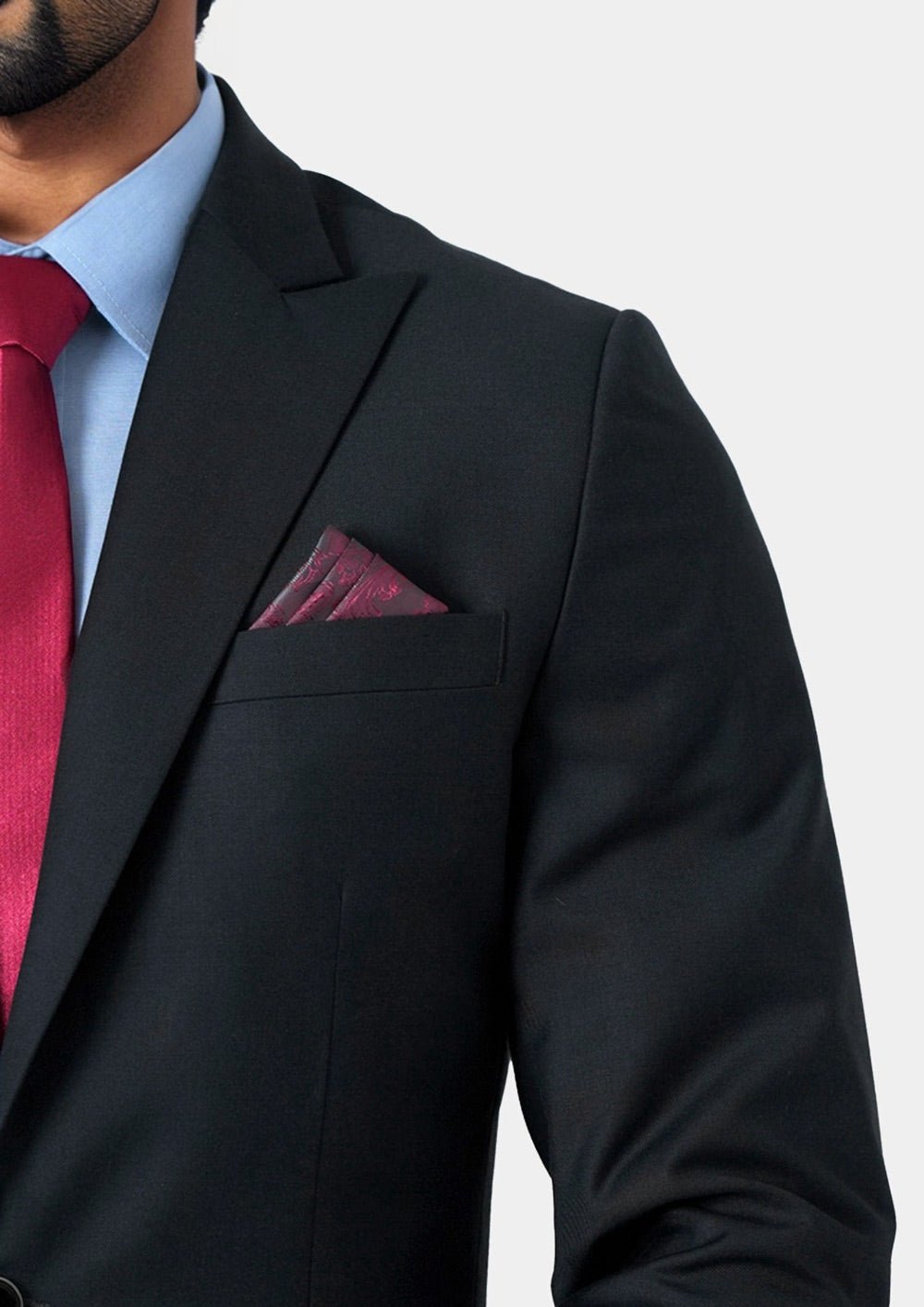
The Bateman silhouette signals authority for reasons that have little to do with the brand names and everything to do with cut. A few principles do most of the work:
- The extended shoulder line adds visual breadth and squares the frame. The effect is that the jacket enters the room before the man speaks.
- The wide peak lapels on the double-breasted direct the eye upward and outward, framing the face and reading as decisive rather than passive.
- The low gorge (the 1980s habit of setting the lapel notch low) positions the tie knot further down and lengthens the "V" of the chest. It looks commanding on screen and dated in person, which is worth knowing before you copy it.
- The contrast collar is a mark of deliberate dressing. A white collar on a colored shirt was never casual, and it signals that the outfit was assembled with intent.
- The conservative palette (charcoal, navy, gray) communicates seriousness without noise. Nothing competes for attention, so the wearer does.
- Braces instead of a belt keep the trouser line clean when the jacket opens, so the silhouette holds even in shirtsleeves.
- Mirror-polished cap-toes extend the precision all the way to the floor. The discipline is consistent from collar to shoe.
These choices reinforce one another, which is easier to see once you understand how a suit jacket's parts work together. The contrast between the imposing double-breasted and the steadier single-breasted also tracks a real structural difference; the distinction between single-breasted and double-breasted suit styles is part of why one look declares and the other simply belongs.
How to Dress Like Patrick Bateman Today, Without the Costume
The common mistake is treating the wardrobe as a shopping list. The wardrobe was designed as a period costume and a satire device; replicating it item for item lands as fancy dress. The useful move is to separate the discipline from the decade: keep what still reads as sharp, drop what only worked in 1988.
What to Keep
- The suit structure. A jacket that holds its shoulder line and drapes cleanly is the whole foundation. Not a sack, not a shrunken slim cut that pulls across the chest.
- The contrast collar. A white or light-contrast collar on a navy or mid-blue shirt adds formality and intentionality to an otherwise plain outfit, used sparingly.
- The palette discipline. Charcoal, navy, and mid-gray as the three anchors. Keep any pattern at a quiet scale: a windowpane check translates cleanly; a wide-spaced pinstripe demands confidence and exact fit.
- One deliberate accent. Blue braces in place of a belt, a silk tie chosen to coordinate rather than match, or a monogrammed cuff. One considered detail, not five.
- Cap-toe shoes. Black cap-toe oxfords or derbies remain the correct anchor for a power-dressing silhouette in 2026.
What to Drop
- The roomy 1980s volume. An oversized chest and full-cut trousers read as deliberate period costume, not precision tailoring. A modern interpretation wants a cleaner, more proportionate line, starting with a suit that fits correctly rather than one sized for drama.
- The aggressive wide pinstripe as the entire outfit. A pattern that broad requires exact fit; without it, it tips into fancy dress. A more restrained suit color that reads as authority does more of the work with less risk.
- The literal red power tie. In the film it is worn as conformity satire. Worn uncritically today, it lands as pastiche.
- Full costume replication. Bateman's wardrobe is a satire device. Wearing it precisely is the joke; wearing its discipline is the lesson.
The power of a suit comes from fit and structure: how the shoulder sits, how the jacket drapes, how the trouser breaks. Those qualities are difficult to reproduce from off-the-rack sizing; they are what a suit built around an individual's proportions is designed to deliver.
Best For
- A high-stakes office presentation or client meeting: the navy windowpane single-breasted, in a modern, proportionate cut.
- A formal event where you want a suit rather than a tuxedo: the charcoal or gray single-breasted (clean, precise, and clearly intentional).
- Black-tie optional: the double-breasted tuxedo silhouette, with satin-faced peak lapels and a butterfly bow tie, holds its own without tipping into costume.


The Satire Everyone Forgets
Somewhere along the way, the internet turned Patrick Bateman into an aspiration. He became a sigma-male icon, a looksmaxxing reference, a "morning routine" quoted sincerely, a symbol of grindset ambition.
Ellis wrote the opposite. Bateman is inherited wealth. He barely works; his position was handed to him; his days are spent on reservations, returns, and the maintenance of surfaces. The grindset projection misses the point entirely. There is no grind, only a man performing the shape of one. As the narration puts it: "there is an idea of a Patrick Bateman… but there is no real me, only an entity, something illusory… I simply am not there."
The grooming monologue (the skincare regimen, the balanced diet and rigorous exercise) now reads as ordinary aspirational content, indistinguishable from a thousand sincere routines online. That collapse is either the joke or the point. The line has become difficult to locate.
The recent quiet-luxury revival, the "stealth wealth" reframing that followed Succession in 2023, has pulled Bateman back into fashion conversation. What draws people to the look now is the discipline and precision of it (the restraint, the consistency, the refusal of noise), not the conformity it was written to mock. That is a more forgiving reading. The irony is worth naming; it does not need a lecture.
FAQ
What suit does Patrick Bateman wear?
In the 2000 film, Patrick Bateman wears four main suits: a navy windowpane single-breasted, a charcoal pinstripe double-breasted (6×2 button, wide peak lapels), a gray single-breasted business suit, and a black double-breasted tuxedo. All were styled by costume designer Isis Mussenden around Cerruti tailoring with a deliberately oversized 1980s silhouette: structured shoulders, a low gorge, and a conservative navy, charcoal, and gray palette.
What brand are Patrick Bateman's suits: Valentino or Cerruti?
Patrick Bateman's suits are attributed to both Valentino and Cerruti, depending on whether you are reading the novel or watching the film. In Bret Easton Ellis's 1991 novel, the dressing monologue names a Valentino Couture tie, Alan Flusser styling, and A. Testoni shoes. On screen in the 2000 film, the suits were Cerruti, with one notable condition: Cerruti agreed to let Christian Bale wear their clothing, but not in scenes where the character was killing anyone.
Is Patrick Bateman's suit double-breasted or single-breasted?
Patrick Bateman wears both double-breasted and single-breasted suits. The most recognizable look (the charcoal pinstripe) is a double-breasted 6×2 with wide peak lapels, often worn with blue braces. His other signature suits, the navy windowpane and the gray business suit, are single-breasted two-button jackets with notch lapels and a low gorge. The double-breasted is the power uniform; the single-breasted suits are the everyday office rotation.
What watch does Patrick Bateman wear?
On screen, Patrick Bateman wears a Seiko SNXJ90: a two-tone automatic with a fluted gold bezel, white day-date dial, and Jubilee bracelet. In the novel, it is a Rolex. Rolex declined to have their watches associated with the character, so the production replaced the Rolex, and the line "Don't touch the Rolex" became "Don't touch the watch."
What glasses does Patrick Bateman wear?
Patrick Bateman wears Oliver Peoples O'Malley frames in the film, not Ray-Ban, which is a common misattribution. His sunglasses are Ray-Ban Wayfarers, which is likely the source of the mix-up.
What tie does Patrick Bateman wear?
He wears silk ties in controlled pattern and color: a light-red patterned tie in the murder scenes, a maroon-with-gold-dots version at lunch with the detective, and a yellow silk foulard with the gray suit. The tie palette follows the same discipline as the suits: restrained, precise, and coordinated with a contrasting shade rather than matched exactly to the cloth.
Why is Patrick Bateman's style considered iconic power dressing?
The look works because every element reinforces the same message: control. The structured shoulder line creates visual authority before a word is spoken; the wide peak lapel on the double-breasted frames the face decisively; the contrast collar signals deliberate formality; the braces keep the trouser sitting clean when the jacket comes off. What makes it unforgettable is the compression of these signals into a uniform: the same precision, every morning, without variation.
How can I dress like Patrick Bateman without looking like a costume?
Take the discipline, not the decade. Keep the structured shoulder and clean drape, the contrast-collar shirt as an occasional formality note, the cap-toe oxfords, and the conservative navy and charcoal palette. Drop the oversized 1980s volume (the roomy chest and full trouser), along with the aggressive wide-spaced pinstripe and any literal replication of the full charcoal double-breasted look. What made the wardrobe iconic was precision and consistency, qualities that depend on fit and proportion, not on matching the exact items.
A suit that works the way Bateman's does (structured, precise, disciplined) depends less on the brand than on how well the jacket is built around the person wearing it. For anyone drawn to that kind of precision, Sartoro builds suits from individual measurements: custom suits.
About the author
Expert insights from our team

Blake Vincent
Senior Menswear Consultant
I’m Blake Vincent, Sartoro’s menswear advisor. I’ve helped over 200 weddings and clients across the USA find clothing that fits their lives and personalities. My goal is to make you look great and feel confident, with honest advice and practical tips—always here if you want to chat about style!
The Wedding Closer
Style & Fit Specialist
Sartoro Blog Contributor


